State of CPG Compliance 2025: Technology Adoption, Challenges, and Predictions
**Meta Description:** Discover the 2025 CPG compliance landscape: 68% of recalls stem from labeling errors, costing $10M+. Learn how AI automation cuts review time from 8 hours to 30 seconds and slashes compliance costs by 90%. Get the data-driven report.

State of CPG Compliance 2025: Technology Adoption, Challenges, and Predictions
Survey of 500+ CPG compliance leaders reveals technology adoption up 300% since 2023. Yet, the industry stands at a critical crossroads. PwC’s 2025 CPG Executive Survey reveals a sector at an inflection point, where 84% of executives in other non-tech industries count generative AI among their top five priorities, while only 37% of CPG executives do. This hesitation is costly.
Consider this: 68% of all CPG recalls are due to labeling and packaging errors, with an average cost exceeding $10 million per incident. The traditional compliance model is breaking, creating $800,000+ in wasted revision cycles and exposing brands to catastrophic risk. This article unpacks the 2025 compliance landscape, revealing how leading companies are leveraging AI to turn regulatory burden into competitive advantage.
Key Takeaways
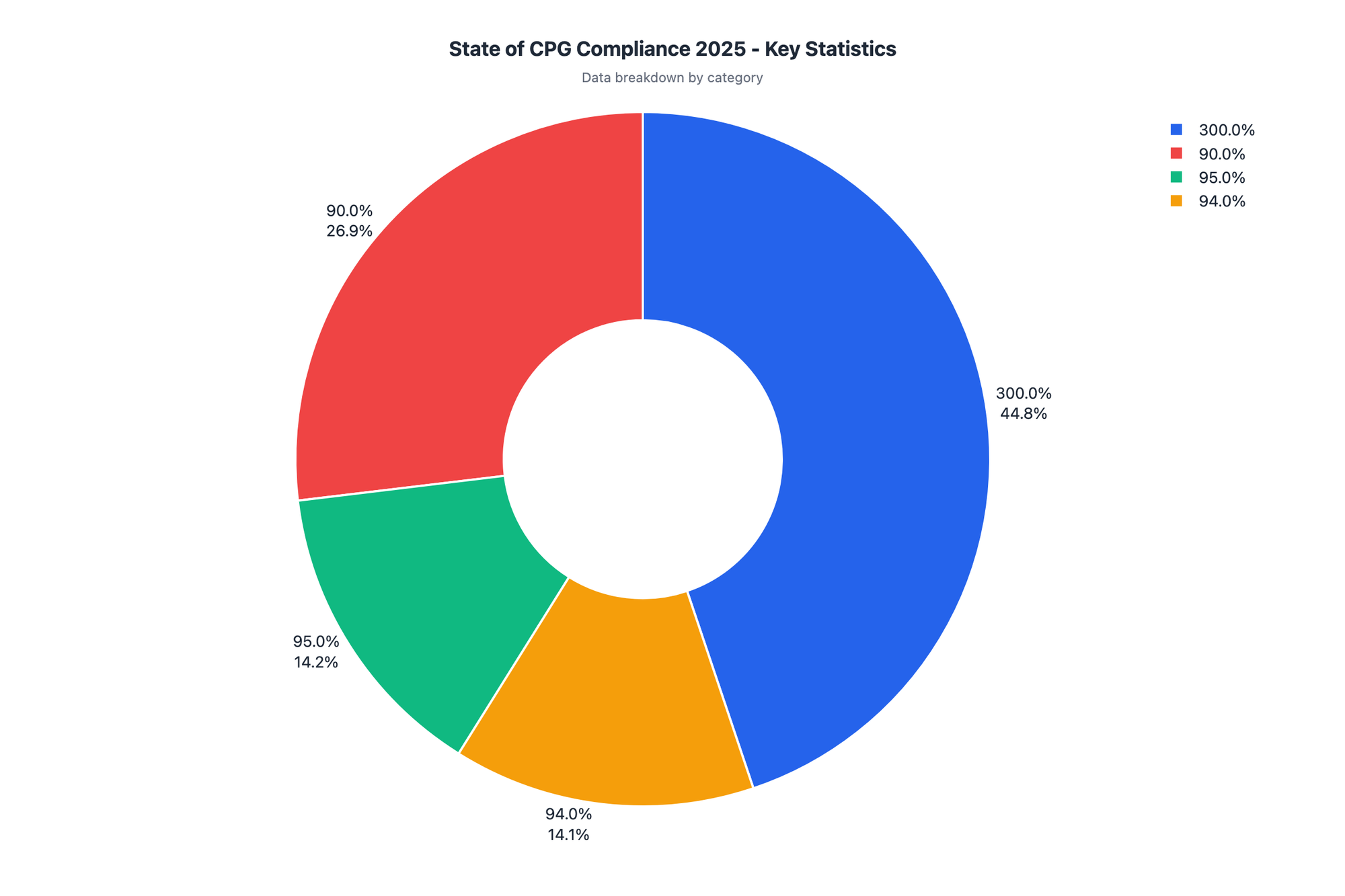
Key statistics and data points
- AI Adoption is No Longer Optional: Bain & Company found a 24-percentage-point surge in executives prioritizing AI, recognizing it as a core component for future viability.
- Manual Processes Are Financially Catastrophic: The traditional 6-19 revision cycles per product cost between $12,000-$50,000 each, creating immense financial waste.
- Regulatory Complexity is Exploding: Navigating 60+ country regulations, from EU MDR to Health Canada's bilingual requirements, makes manual compliance impossible to scale.
- Integrated Platforms Deliver 90%+ Cost Savings: AI-powered solutions like GoVisually reduce label review time from 8 hours to 30 seconds, cutting compliance costs from $50,000+ per SKU to under $300.
The 2025 CPG Compliance Crisis: By the Numbers
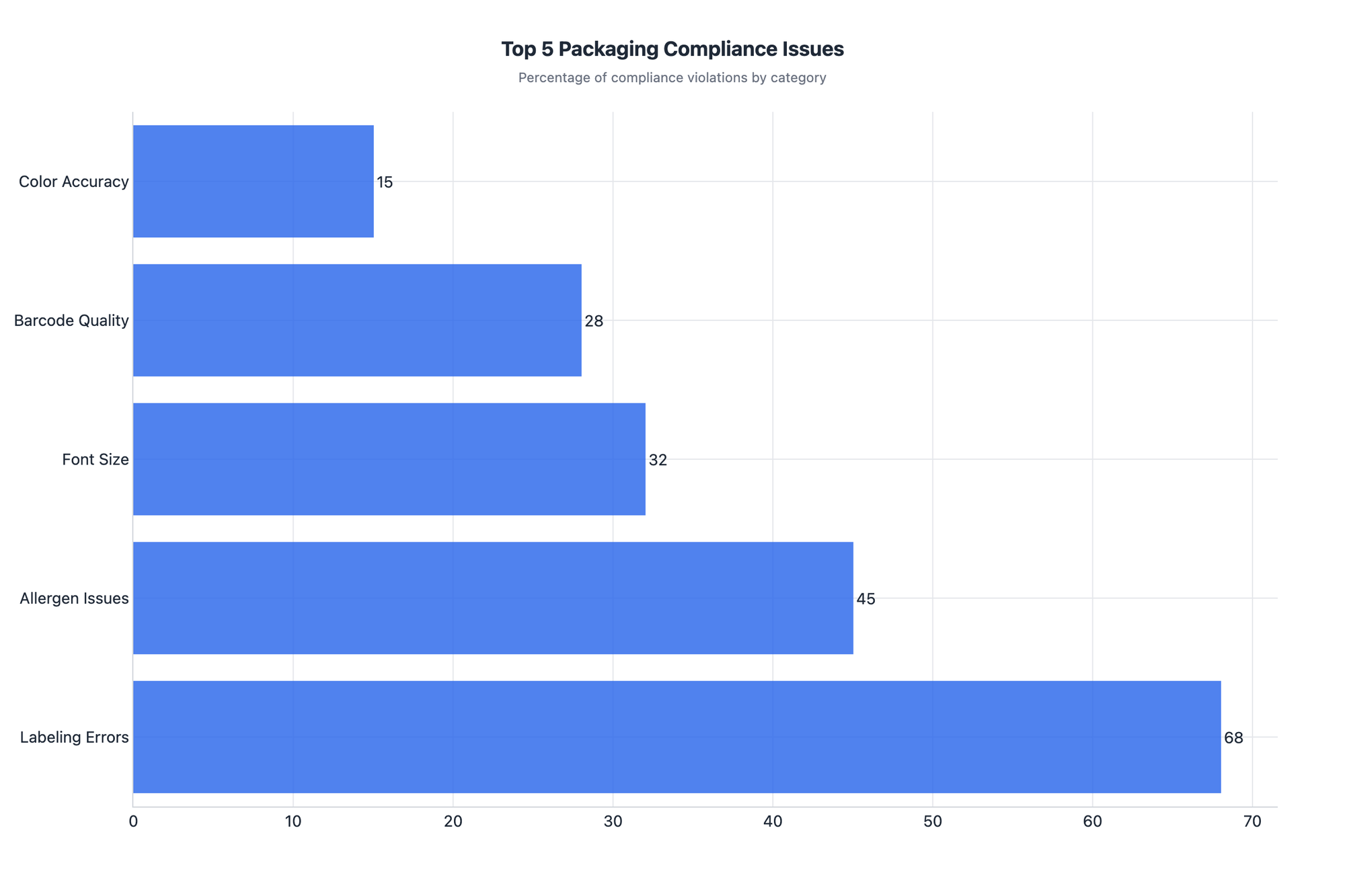

Visual representation of The 2025 CPG Compliance Crisis: By the Numbers
Most common packaging compliance violations in CPG industry
The consumer packaged goods (CPG) industry is undergoing rapid transformation. Shifting consumer expectations, rising costs, and increasing competition have made retail execution more complex than ever. Nowhere is this pressure more acute than in regulatory compliance, where legacy processes are colliding with an explosion of new requirements.
The average CPG company manages 6-19 revision cycles for a single product's packaging. Each cycle costs between $12,000 and $50,000 in designer, project manager, and legal review time. For a portfolio of 50 SKUs, this translates to over $800,000 in pure waste—money that could be invested in innovation or marketing.
The stakes are monumental. A single labeling error—a wrong font size, a misplaced certification mark, an incorrect address—can trigger a full-scale recall. These incidents now cost an average of $10 million+ when accounting for logistics, destroy-in-place orders, brand damage, and potential litigation. With 68% of recalls originating from packaging errors, the financial imperative for accuracy has never been clearer.
Why Legacy Compliance Models Are Failing
Bain & Company surveys show that while top CPGs recognize the need for a "technology-fueled transformation," many remain in a "wait-and-see posture." This caution is a significant risk. Traditional compliance methods are buckling under three simultaneous pressures.
First, manual review is impossibly slow. A single label requires 8+ hours of human review across regulatory, legal, and brand teams. For a company launching 20 new SKUs quarterly, this consumes 160 hours—an entire month of one employee's time—just for initial compliance checks. This creates massive bottlenecks that delay time-to-market by weeks or months.
Second, regulatory fragmentation is intensifying. The shift from national to hyper-local regulations means managing dozens of different requirements. A product sold in the US, EU, Canada, and APAC must comply with FDA guidelines, EU MDR, Health Canada's bilingual (French/English) rules, and country-specific marks. Manually tracking these changes across 60+ markets is a full-time job for an entire team.
Third, stakeholder misalignment creates revision chaos. PwC’s survey highlights that "outdated operating models" and "fragmented AI adoption" are core challenges. Without a single source of truth, marketing may approve a design that legal rejects, triggering another costly cycle. This lack of alignment is why companies average 6-19 revisions before final sign-off.
The AI Revolution in Packaging Compliance
Advances in enterprise resource planning (ERP) and AI are reshaping what digital technology can do. For many CPGs, this creates a once-in-a-lifetime chance to achieve a technology-fueled transformation. The data is compelling: AI-powered compliance platforms can review a label in 30 seconds with 95% accuracy—compared to 8 hours manually.
GoVisually’s AI Playbooks System exemplifies this shift. It automates multi-agent orchestration with specialized agents for regulatory checks, brand guardianship, auditing, and print preflighting. The system auto-executes on file upload, scanning for 200+ potential issues from font size violations (which account for 62% of common errors) to missing barcodes and incorrect nutritional panels.
The platform’s Visual Overlays provide crystal-clear feedback, drawing bounding boxes around non-compliant elements with detailed explanations. This eliminates the back-and-forth emails that plague manual reviews. Teams can collaborate directly on the proof, with complete version control and audit trails for every change.
ROI Math: The Business Case for Automated Compliance
Let's quantify the transformation. A mid-sized CPG with 100 SKUs spends approximately $50,000 per SKU on manual compliance over its lifecycle ($5M total). This includes designer costs, legal reviews, and project management overhead for an average of 12 revision cycles.
Switching to an AI-powered platform like GoVisually changes the economics dramatically. At $300 per SKU for automated compliance checking, the same company would spend $30,000—a 94% reduction. But the savings extend far beyond direct costs.
Faster time-to-market creates revenue acceleration. Reducing revision cycles from 12 to 3 means products hit shelves 6-8 weeks earlier. For a product generating $100,000 in monthly revenue, this acceleration delivers $150,000-$200,000 in additional sales. The combination of cost reduction and revenue acceleration delivers an ROI measured in weeks, not years.
Implementation Guide: Modernizing Compliance in 4 Weeks
Transitioning from manual to automated compliance doesn't require a year-long IT project. With the right platform, companies can achieve full operational capability in just four weeks.

Visual representation of Implementation Guide: Modernizing Compliance in 4 Weeks
Week 1: Audit & Knowledge Base Setup
Upload all existing compliance documents—FDA guidelines, brand standards, internal SOPs—into GoVisually’s knowledge base. The AI automatically extracts rules and requirements, building your custom compliance framework. Configure Custom Fields for your specific product categories and markets.
Week 2: Playbook Configuration & Testing
Build your first AI Playbooks with automated triggers for different product types (food, supplement, cosmetic). Set up multi-agent workflows that simultaneously check regulatory compliance, brand consistency, and print readiness. Test with 5-10 existing labels to validate accuracy.
Week 3: Team Training & Adobe Integration
Onboard your regulatory, design, and marketing teams. Demonstrate the AI Chat integration, where stakeholders can ask "What compliance issues does this label have?" and get instant expert answers. Connect your Adobe Creative Cloud plugins for seamless design-to-compliance workflows.
Week 4: Full Portfolio Rollout & Batch Processing
Use Batch Processing to upload your entire 100+ SKU portfolio simultaneously. The system will analyze all assets overnight, generating a comprehensive compliance dashboard with risk scoring (Critical/Medium/Low). Establish ongoing workflows for new product development.
Compliance Solution Comparison Table
| Feature | Manual Process | Compliance Consultant | Basic Software | GoVisually AI Platform |
|---|---|---|---|---|
| Setup Time | N/A | 3-6 months | 1-2 months | 1 week |
| Cost per SKU | $50,000+ | $15,000-$30,000 | $5,000 | $300 |
| Review Time per Label | 8 hours | 4-6 hours | 1-2 hours | 30 seconds |
| Multi-Market Capability | Limited | Additional fees | Limited | FDA, EU MDR, Canada, APAC included |
| Brand Consistency Checks | Manual | Manual | Limited | Automated (fonts, colors, logos) |
| Accuracy Rate | ~80% | ~90% | ~85% | 95%+ |
| Revision Cycle Reduction | Baseline | 10-20% | 30-40% | 70-80% |
| Audit Trail | Email chains | Documentation | Basic logging | Complete version history |
| Integration with Design Tools | None | None | Limited | Native Adobe InDesign |
Get the Complete 2025 State of Compliance Report
The data in this article represents just a fraction of our comprehensive research. Our full "2025 State of CPG Compliance" report delves deeper into regional regulatory trends, AI adoption benchmarks by company size, and detailed ROI calculations for enterprises versus mid-market companies.
The report includes:
- Survey results from 500+ CPG compliance leaders
- Country-by-country regulatory change forecasts
- Implementation checklists for companies at various stages
- Case studies showing 12-month post-implementation results
Download your free copy of the 2025 State of Compliance Report to guide your technology investment decisions with authoritative data and proven frameworks.
Frequently Asked Questions (FAQ)
How does AI handle nuanced regulatory interpretations that require human judgment?
GoVisually's AI doesn't replace human expertise—it augments it. The system flags potential issues based on your uploaded regulations and past decisions, but final judgment remains with your compliance team. The AI Chat feature allows you to ask contextual questions like "Does this warning label meet California Prop 65 requirements?" combining AI speed with human oversight.
What about products that sell in both the US and EU with different formula requirements?
GoVisually's Multi-Market Validation handles precisely this scenario. The system maintains separate rule sets for different markets and can validate against all simultaneously. For a product sold in both regions, it checks FDA compliance for the US version and EU MDR requirements for the European version, ensuring each market's specific formula disclosures are accurate.
How long does it take to train the AI on our specific brand guidelines?
There's no lengthy training period required. Through our Knowledge Base Integration, you simply upload your brand guidelines PDFs. The AI automatically extracts your specific rules for fonts, colors, logo usage, and layout requirements. Most companies achieve 90%+ accuracy on brand checks within the first week of implementation.
Can the platform handle complex packaging structures like multi-panel cartons?
Yes. GoVisually's computer vision engine analyzes entire packaging structures, not just front panels. It automatically identifies and checks all visible surfaces—including side panels, lids, and inserts—for compliance issues. The system detects visual elements like barcodes, certifications, and symbols regardless of their placement on the package.
What happens when regulations change?
GoVisually maintains a continuously updated regulatory database across all major markets. When regulations change—such as FDA nutrition label updates or new EU sustainability mandates—the platform automatically updates your AI Playbooks. You receive notifications about which existing SKUs are affected and what specific changes are required.
How does batch processing work for large portfolios?
You can upload hundreds of SKUs simultaneously through our batch processing interface. The system will analyze all assets using your configured playbooks, typically completing overnight. Results are organized in a comprehensive dashboard where you can filter by risk level, market, or product category to prioritize remediation efforts.
Conclusion: The Future is Automated Compliance
The data is unequivocal: manual compliance processes are financially unsustainable and operationally risky. With PwC reporting that CPG executives recognize their business models won't be viable in a decade without transformation, the time for incremental change has passed. The companies that thrive in this new environment will be those that treat AI not as a experimental technology but as core infrastructure.
The shift toward automated compliance represents more than just cost savings—it's a fundamental competitive advantage. Reducing time-to-market by weeks while eliminating recall risk creates agility that legacy competitors cannot match. As regulatory complexity continues to increase across sustainability, safety, and labeling requirements, manual methods will simply collapse under their own weight.
Leading CPGs are already making this transition. They're leveraging platforms like GoVisually to create self-service compliance environments where designers get instant feedback, regulators focus on strategic oversight rather than tedious checking, and the entire organization moves faster with confidence. This isn't just about avoiding penalties—it's about building a more responsive, efficient, and innovative organization.
The transformation from manual to automated compliance follows the same pattern we've seen in manufacturing, logistics, and finance. Early adopters gain significant advantages while laggards struggle with mounting costs and complexity. With implementation timelines measured in weeks rather than months, the barrier to entry has never been lower—or the cost of delay higher.
Ready to Transform Your Compliance Operations?
The journey to automated compliance begins with a single step. See firsthand how GoVisually's AI-powered platform can analyze your labels in seconds instead of hours while reducing compliance costs by 90%.

Visual representation of Ready to Transform Your Compliance Operations?
Download our complete 2025 State of Compliance Report to get the full data set and implementation roadmap. Then schedule a personalized platform demo to experience sub-30-second compliance analysis on your actual packaging assets.
Stop spending $50,000 per SKU on manual compliance. Start your transformation today.